

How Lineage supports ice cream storage, case picking and distribution
Service spotlight
October 26, 2026
Developed with subject matter expertise from Chris Britton, VP, Business Development, and Mitch Perry, GM, West Region 10.
Finding warehouse space for ice cream can be a challenge even when there’s frozen storage nearby. Your product may need a colder room than most facilities can provide. You may need individual cases picked for store deliveries. And if your inventory takes up only a small part of a freezer, paying to dedicate an entire room to it can be hard to justify.
These are familiar conversations for Lineage’s team, with more than 70 facilities offering ice cream capabilities across our global network. Our Lancaster, Texas facility, for instance, combines approximately −20°F ice cream storage with case picking and space for customers whose inventory doesn’t require a room of its own. It’s one example of how Lineage supports ice cream and frozen dessert businesses across our global network, matching specialized storage needs with the work required to get orders out the door.
Ice cream cold storage requires facilities built for lower temperatures
Temperature is usually the first thing prospective ice cream customers ask the Lancaster team about. Many of the manufacturers they work with are looking for storage around −20°F to help preserve their product’s quality. The exact requirement depends on the product and the customer’s specifications.
Reaching that temperature isn’t standard in every frozen warehouse. The refrigeration system has to support it, as does the structure itself. The building’s floors, piping and even the temperature of an adjacent room can make a difference. Converting an existing chamber often involves changes to the building as well as its equipment.
For a manufacturer or distributor comparing ice cream cold storage options, that makes it useful to ask how a facility operates at the required temperature. How is the room monitored? Where does picking happen? Where will a finished order wait for its truck? The answers reveal how experienced the team is and whether or not the warehouse itself can handle your product.
Inside the Lineage Lancaster’s −20°F ice cream storage operation
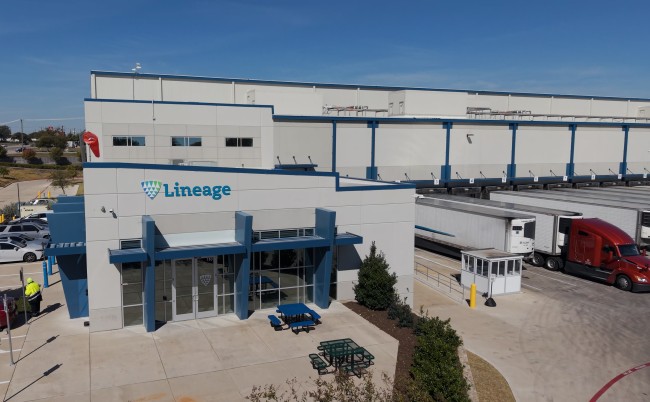 In Dallas-Fort Worth, Lineage’s Lancaster facility has a chamber with approximately 4,000 pallet positions capable of operating around −20°F. The building was designed with that low-temperature capability, and the team has developed its ice cream operation around it.
The existing room gives customers with smaller inventories an option that doesn’t require taking on an entire chamber. Some businesses might need 1,000 pallet positions but face the cost of a much larger room if a provider has to convert space specifically for its products. Lancaster can accommodate smaller programs within its established ice cream chamber.
The team checks freezer temperatures twice daily, at the beginning of each shift, and uses alerts to help monitor conditions. Customers also work with the facility to establish receiving requirements, including which code dates and product information need to be captured when a shipment arrives.
That combination is particularly relevant for businesses that turn inventory regularly and need frequent order preparation, even if they don’t need a large amount of storage.
Case picking inside the freezer keeps ice cream cold during order preparation
Most outbound orders don’t look like the original pallet that came in. For store deliveries, customers may need individual cases selected from different pallets and assembled into a new load. This case picking process is a regular part of Lancaster’s ice cream operation.
The work happens inside the approximately −20°F freezer. Team members select the required cases, build the outbound pallet and leave the completed order in frozen storage until loading begins.
It’s hands-on work in a demanding environment. Heated gloves, heated vests and specialized freezer jackets help keep the Lancaster team safe while protecting the temperature-sensitive products before reaching their next destination.
The facility can also ship full pallets and support handling needs like down-stacking and consolidation. These options give customers more control in how their ice cream is handled, from receiving to shipping.
Prompt receiving and pre-cooled trailers limit ice cream’s time on the dock
A cold room can only do its job while the product is inside it. Receiving and shipping procedures deserve the same attention as the storage temperature itself.
Incoming loads are handled one pallet at a time. After trailer checks, team members unload, inspect and scan each pallet according to the customer’s requirements, then move it right into the freezer. Product spends as little time as possible on the dock.
For outbound orders, the sequence matters just as much. The trailer must be at the door and cooled to the required temperature before the team brings the order out for loading. Until then, the prepared pallet waits inside the freezer.
Keeping picking and staging in the cold room helps limit exposure to warmer conditions as ice cream moves through the facility.
Keep your ice cream supply chain connected, from storage to distribution
Lineage’s network includes facilities with ice cream handling capabilities across North America, Europe and Asia-Pacific. Locations include Lancaster, Texas; McDonough, Georgia; Mira Loma, California; Calgary, Canada; Bellshill, United Kingdom; and Dandenong South, Australia.
Through Lineage’s Global Integrated Solutions, that support extends beyond the warehouse. Select Velocities multivendor consolidation locations support ice cream programs for retail customers, combining shipments from multiple vendors into consolidated loads. Over-the-road transportation provides another way to move ice cream toward its next destination.
For businesses planning where to hold inventory, that geographic reach provides multiple locations to consider. Temperature ranges, handling services and capacity vary by facility, so each location needs to be matched to the product and the distribution plan.
Lancaster is just one example of what that match can look like: a freezer suited to the required temperature, room for smaller inventories and an experienced team that knows what it takes to protect these products. For an ice cream business, those details matter. The right warehouse gives each order the space, handling and cold conditions it needs until the trucks are ready.
