Boyle Heights Response & Recovery
Questions & Answers
Top Questions
-
Lineage made transparency and open communication a priority throughout the response and recovery effort.
Within 48 hours we established a public information hub dedicated to the Boyle Heights Response & Recovery. This page has been updated frequently so residents can access the latest information on recovery efforts, cleanup progress, air monitoring information, community support resources, and answers to frequently asked questions. We have distributed flyers in the community and run both digital ads and bilingual radio ads to help residents find this page and information.
In addition, we have issued regular public updates (many of which have been shared by media outlets) and added direct channels (BoyleHeights@onelineage.com, a bilingual phone line, and online request form) for community members to ask questions and share concerns.
More photos, videos and cleanup updates are also posted on our dedicated Instagram account – @lineagelospalos – for community members who prefer to get their news from social media.
While the situation was dynamic throughout each phase of this cleanup, we remain committed to providing timely, accurate, and fact-based information to residents and community leaders.
-
Lineage made transparency and open communication a priority throughout the response and recovery effort. We have maintained ongoing, consistent communication with local, county, state, and federal agencies, as well as elected officials, throughout the entire fire response, cleanup, and recovery process.
This included:
- Publishing daily reports and regularly sharing information regarding site conditions, cleanup activities, air monitoring results, and recovery plans, while also responding to agency and stakeholder questions as part of an ongoing meeting schedule with the Boyle Heights Unified Recovery Command, which includes representatives from many offices and agencies. Those offices and agencies include:
- The Mayor's Office, Los Angeles City Council offices (including CD-14), the Emergency Management Department, Fire Department, Police Department, Department of Water and Power, Board of Public Works, Recreation and Parks, City Administrative Office, and City Attorney's Office. County participants have included the Office of Emergency Management, Department of Public Health, Department of Public Works, County Fire Department, Board of Supervisors staff, County Counsel, and other county agencies. State and regional partners have included Cal OES, CalEPA, and the South Coast Air Quality Management District, among others.
- Participating in briefings, meetings, and site visits to provide updates and ensure officials have current information about response and recovery efforts. This includes:
- A weekly meeting with representatives from CD-14, the Mayor’s Office, County Supervisor’s Office, and more than 20 Boyle Heights community organizations including Proyecto Pastoral, Dolores Mission, Inclusive Action, and Alliance of Californians for Community Empowerment (ACCE) focused on Lineage’s door-to-door canvassing and community impact efforts.
- A weekly meeting with representatives from CD-14, the Mayor’s Office, County Supervisor’s Office, LA Emergency Management Department (EMD), LA County Emergency Management (OEM), State Senator’s Office, LAUSD, LAFD and the Department of Public Health to discuss community impact efforts and overall cleanup progress.
- No agency officials who have requested a site tour or arrived unannounced have been turned away from inspecting the facility firsthand. We believe it is important that officials and regulators understand the complexity and challenges of this situation so we can work cooperatively on the fastest cleanup possible without sacrificing health, safety and regulatory compliance.
Our teams worked around the clock on cleanup and recovery and communicated the challenges we faced meeting the 45-day deadline set in the Mayor’s executive order. We did our best to meet that timeline with the underlying goal of getting the job done as quickly as possible. At no point did city, county or state officials offer resources or suggest alternative strategies that would have expedited cleanup efforts.
- Publishing daily reports and regularly sharing information regarding site conditions, cleanup activities, air monitoring results, and recovery plans, while also responding to agency and stakeholder questions as part of an ongoing meeting schedule with the Boyle Heights Unified Recovery Command, which includes representatives from many offices and agencies. Those offices and agencies include:
-
Yes. Independent monitoring from Onterris as well as the South Coast Air Quality Management District (SCAQMD) is running around the clock at multiple locations in and around Boyle Heights. Readings have consistently shown results within normal levels for the neighborhood and no harmful health impacts. Air monitoring data is accessible on this page and on aqmd.gov. We want you to have the facts, not just our word.
-
Soon after the fire started, we pumped all the ammonia from our cooling systems and safely transported it offsite. No ammonia was released from the cooling system as a result of the fire, and no ammonia levels that would pose a health risk have been detected in the community at any time since the fire started. We know some neighbors have also asked about methane and hydrogen sulfide — these chemicals are included in our air monitoring. To date, monitoring has not detected levels of these chemicals or particles that pose a health risk. Lastly, while odors that come from decomposing food are unpleasant, we want to confirm that allergens associated with any of these foods are not airborne or distributed as a result of organic decomposition — meaning those with allergies to certain foods are not at greater risk during this period.
We also wanted to clarify that ammonia is a naturally occurring compound that is created during the decomposition process. Accordingly, ammonia was detected in community air monitoring while cleanup was ongoing as food decomposed; however, the levels of ammonia detected were well below those that would pose a risk to community health. Detections of ammonia created by the decomposition of food on site then steadily decreased as the cleanup progressed. At no point did community ammonia levels pose risk to community health.
-
The fire started on the roof of the facility on June 17. It was declared knocked down by the LAFD on June 29. Firefighting activities continued at the site subsequently, and the last reported flareup within the debris occurred over the July 4 weekend. That allowed us to begin dismantling the burned structure on July 7. Lineage worked closely with the Los Angeles Fire Department and other agencies to support their efforts to fight the fire and protect the community. To augment their brave and tireless efforts, we leveraged our network to source high-powered water cannons from Texas, funded helicopters to continue water drops, and partnered with other industrial companies to secure additional equipment to speed up fire suppression efforts.
-
We understand the frustration and shared the community’s desire to see the cleanup completed as quickly as possible. From the beginning, our focus was on moving as fast as we could while making sure the work was done safely and done the right way.
We operated with the highest degree of urgency the minute the fire broke out and well before we were given control of the site.
The Los Angeles Fire Department controlled the site while they battled the fire and ensured the structure was safe to enter. Lineage did not control the site to start the cleanup until LAFD finished monitoring for hot spots and vacated the site on the evening of July 6.
That said, we did not sit on our hands during that period. We engaged and mobilized hundreds of contractors and emergency response and environmental experts, so that they and their equipment could be onsite to begin working around the clock as safety and engineering checks were completed and access was granted.
These cleanup crews then worked on-site around the clock to remove food waste, clear debris and dismantle damaged sections of the structure. However, this was, from the beginning, a highly complex operation. The warehouse contained approximately 88 million pounds of food, and the fire damaged parts of the structure, making it dangerous to safely access and remove food debris from much of the building until conditions were fully assessed by structural engineers and other experts.
To support the cleanup, we brought in specialized contractors and equipment from across the country; however, much of this equipment was not originally designed for conditions like these, so our teams had to continually adapt their approach as site conditions changed—including continually repairing and reassembling equipment as it continually broke down.
Throughout the process, we evaluated new strategies, adjusted our operations when needed and constantly looked for ways to improve efficiency while reducing impacts on the surrounding community.
The work was also being carried out under strict safety and environmental requirements and in coordination with local, county, state, and federal agencies.
While we did everything we could to move quickly, not every aspect of the cleanup was solely within our control. Some activities required agency coordination, approvals, or direction, which impacted the pace of progress. We also worked throughout the process to address questions, concerns, and requests from public officials, community groups, and residents.
Senior company leaders were actively involved every day, helping identify and remove barriers that could slow progress. As many of the initial obstacles were addressed, food removal and overall cleanup efforts gained momentum over time.
We—like everyone else—wanted this site cleaned up as soon as possible. From the outset, the Lineage team remained committed to moving the work forward as safely, responsibly and as quickly as possible. We are proud of the performance of our extended Lineage team and the tremendous work they accomplished in unprecedented conditions.
-
Reducing odors was a key priority during the cleanup effort. Lineage put several odor-control measures in place early on and worked with South Coast AQMD to identify additional solutions to reduce odors where possible.
Efforts included:
- Fixed odor-control spray systems were installed around the building to deodorize the air and odorous material around the site, as well as a tracked robotic spray system.
- Odor neutralizer was applied to waste materials multiple times each day.
- Portions of the building were wrapped to help keep odors contained
- Nine heavy-duty air scrubbers that pull air through carbon filters to help absorb odors were installed on parts of the facility, with more on the way.
- Runoff collection areas, loading zones and drains were cleaned daily.
- The roll-off bins into which food waste was loaded were sealed immediately once full. These sealed bins then left the site as soon as possible. Bins may have been staged on site depending on truck route availability; however, they were removed as soon as there was a truck able to do so.
- Once trucks were loaded, they promptly left the facility in accord with approved truck routes.
Lineage has also conducted continuous monitoring of air quality in the nearby community and shared air-monitoring data with both local regulators and the public on our website.
We worked as fast as we safely could to get food debris out of the building, and we understood the importance of reducing odors and minimizing impacts on the surrounding community while this essential cleanup work took place. Second only to safety, removing all food waste was our top priority from the beginning.
-
Lineage expanded its pest-control efforts with support from Orkin to help reduce fly and rodent activity around the site and minimize impacts on nearby residents and businesses.
Some of the steps put into place included:
- Daily fly-control treatments, with additional service added if needed.
- Daily inspections of the property perimeter for signs of rodent activity.
- Rodent-control devices installed around the site in strategic locations.
- Exterior fly-control devices installed, including bait stations and fly traps, to help reduce fly populations.
- Targeted fly treatments around dumpsters, loading areas, drainage areas, fence lines, and other locations where flies are most active.
- Ongoing monitoring to track pest activity and adjust control measures as needed.
- Sanitation and cleanup efforts to remove materials and conditions that can attract pests or create breeding areas.
In response to feedback from families in nearby homes, Lineage also distributed thousands of fly traps to community members through its ongoing neighborhood outreach efforts.
Throughout the cleanup process, we did our best to continue monitoring conditions, listen to our neighbors’ concerns and adjust our pest-control efforts as cleanup work progressed.
-
On September 22, LAFD released its investigation report into the cause of the fire. According to the report, investigators determined the fire "originated on the roof" on the Union Pacific Avenue side of the building. Fire patterns inside show it traveled "from the top down" into the warehouse. Investigators searched for other accidental causes throughout their investigation, such as discarded smoking materials or open flames, and found no evidence of them. The only source it could not rule out is "solar panels and their connected components."
The report also noted that LAFD’s Hazardous Materials team monitored inside the building and the surrounding outdoor areas. It reported all readings “within normal limits for a common structure fire, with no ammonia detected.”
We want to be clear that this fire was not caused by our operations or our team. We believe the fire started on the roof when a contractor of the owner of the solar array, Altus Power, was testing the array. Regardless of how the fire started, Lineage has been on the front lines since day one, and we are committed to doing everything in our power to execute a safe and swift remediation effort.
Further Questions & Answers
-
How did the fire start?
On September 22, LAFD released its investigation report into the cause of the fire. According to the report, investigators determined the fire "originated on the roof" on the Union Pacific Avenue side of the building. Fire patterns inside show it traveled "from the top down" into the warehouse. Investigators searched for other accidental causes throughout their investigation, such as discarded smoking materials or open flames, and found no evidence of them. The only source it could not rule out is "solar panels and their connected components."
Based on all available information, we believe the fire was ignited on the roof while subcontractors working for Altus Power, which owns and operates the solar array on the roof of the facility, were working on the solar array.
This was not Altus’ first fire at this site. In August 2024, the same solar array sparked a smaller fire at the Los Palos Street facility. Lineage demanded enhanced safety measures, and Altus retained Pearce to reconfigure the array. By May 2026, inspectors had identified more than 200 connector failures across the array, including in the section where the June fire would begin.
On June 11, 2026, Lineage notified Altus in writing that the system should not be re-energized until critical safety tests were completed and Lineage representatives had conducted a full on-site walk-through, scheduled for June 22-23. Altus and Pearce deliberately ignored those instructions. Beginning on June 5 and continuing through June 17, the array was energized without completing the required testing, without Lineage's knowledge, and before all work on the array had been completed. The fire ignited on June 17 while Pearce personnel were working on the energized system.
-
We can confirm that no ammonia was released from the cooling system as a result of the fire, and no measurable ammonia concentrations have been recorded in the community since the fire began that would pose a health risk. We also proactively took steps to pump out the ammonia and transport it offsite, removing the possibility of ammonia posing a risk to the community.
-
Ammonia is one of the gases produced during the process of food waste decomposition. As part of the cleanup and remediation, Lineage contracted Onterris to conduct air monitoring for various chemicals including ammonia. The reports are published on Lineage’s dedicated air monitoring webpage. Importantly, air monitoring has not identified ammonia concentrations above health-based action levels in the community since monitoring began.
-
Lineage has consistently supported the community throughout the emergency response and subsequent cleanup and recovery efforts.
Early on, we were encouraged by local officials to contribute to the California Community Foundation to unlock immediate relief and support to area residents. Accordingly, Lineage donated $2 million to the California Community Foundation which was then distributed to more than 20 organizations providing additional support; view the list here. These groups were funded to provide: air purifiers and PPE, food and household supplies, medical and mental health services, housing assistance, cash assistance, small business support and community outreach.
In addition, during those initial weeks, our team directly distributed a further 7,000 meals via the LA Regional Food Bank, over 3,500 meals via food trucks, over 7,000 cases of water and funded food transportation costs for 4 local food pantries. Our team also supplied over 2,000 masks and 600 air purifiers.
We also conducted an intentional and systematic program of door-to-door outreach to the households located nearest our facility to offer those families support in the form of: vouchers for short-term housing, grocery vouchers, air purifiers, air conditioning units, and masks. We provided utility bill support through LADWP and SoCal Edison, as well as a direct cash assistance program to this same group. Because those located closest to the site were most impacted, residents were eligible for varying levels of support based on their proximity to the facility.
-
Lineage provides temperature-controlled warehousing and supply chain solutions for the storage, handling, and movement of food and other temperature-sensitive products. We serve thousands of customers including some of the world’s largest food and beverage producers, retailers, and distributors to help feed the world.
-
To be clear, we do not store hazardous chemicals or products in this facility. We store food. Frozen food products are kept in buildings like ours before being sent to grocery stores and restaurants throughout the community.
Our warehouse is like a huge version of the freezer in your home. And, like the freezer in your home, our facility requires a basic chemical reaction to reduce the temperature.
Ammonia is the chemical that allows us to cool our building.
Ammonia is the dominant refrigerant in the cold storage industry—with industry reports estimating it in use at over 90% of refrigerated warehousing facilities in the United States
Ammonia is naturally occurring and is considered the more sustainable and environmentally friendly alternative to other synthetic refrigerants, which generate potent greenhouse gases. Ammonia has been assessed as having zero global warming potential (GWP)—in other words, ammonia does not contribute to the greenhouse effect responsible for global warming.
-
Cold storage is a critical part of the global food supply chain. Maintaining the proper temperature helps protect food quality and safety, reduce waste, and enables products to move efficiently from producers and importers to the communities they feed. Although they operate behind the scenes, cold storage facilities play an important role in helping keep food moving safely from where it’s grown or produced to grocery stores, restaurants, and communities.
-
The facility supports a variety of roles that help keep food moving on its journey to your table, including warehouse operations, logistics and transportation coordination, maintenance, customer support, and administrative functions.
We are grateful to report that all employees were safely evacuated and no injuries have been reported. The safety of our employees, partners and surrounding community remains our highest priority.
We are supporting team members impacted by providing resources through our Employee Assistance Program and having them report to other buildings in our network where possible.
-
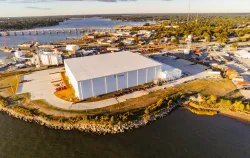
The Big Bear facility located in Boyle Heights is part of Lineage's Southern California network, which helps support the movement of temperature-controlled products through one of the nation's most important trade gateways. Located near the Ports of Los Angeles and Long Beach, the facility is part of a network that helps connect food products to 10 million people in communities throughout Southern California and beyond.
-
Southern California is home to the largest import hub in the U.S. Products like seafood, pork, beef, and poultry from major markets around the globe travel through here for regional distribution for West Coast grocery stores, restaurants, and more. Facilities like Big Bear help maintain the cold chain by keeping temperature-sensitive products at the proper temperature as they move through the food supply chain. From arrival at port to their next destination, these facilities help ensure products are handled safely and efficiently while preserving quality and freshness.
-
We believe the fire was caused by Altus Power – the owner of the rooftop solar array – and its contractor Pearce Services LLC, who ignored safety warnings and Lineage’s explicit written instructions, re-energizing a defective rooftop solar array days before the fire.
-
As the operator of the facility, we did not wait for fault to be assigned. We moved immediately because we were best positioned to understand the complexity of the cleanup and because it was the right thing to do for the community. Accountability for the cause of the fire is a separate matter that will be addressed through the appropriate legal processes.
-
Cold storage facilities operate under strict building codes and are equipped with fire suppression systems. The fire at Los Palos originated on the roof during third-party work by Altus Power's subcontractors — not within the cold storage operations themselves. We are evaluating all aspects of the facility's safety protocols as part of our broader review.
Looking for More Information?
Click below for community resources, frequently asked questions, progress updates and additional resources.